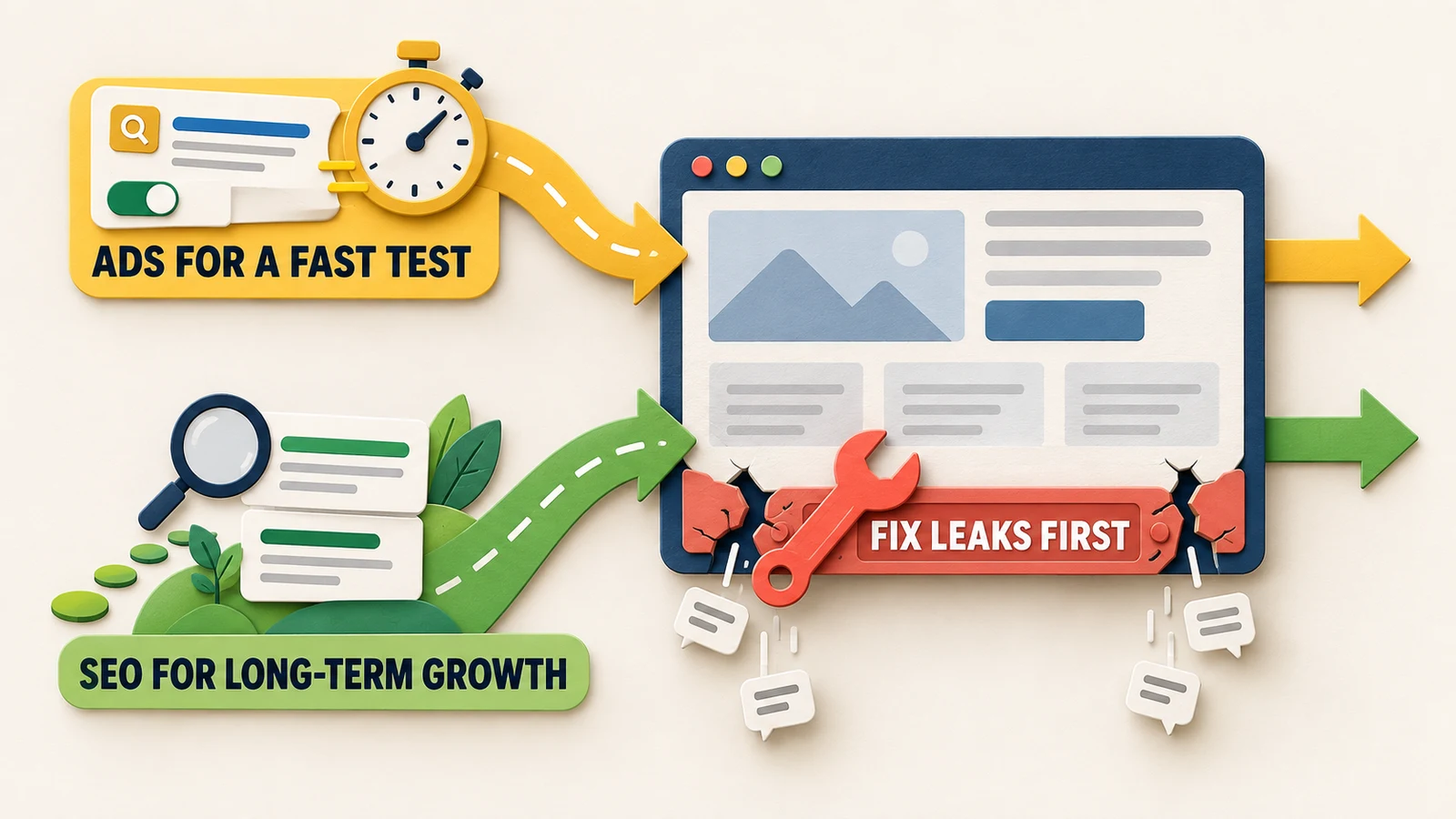
Improve the website first if it is difficult to use, does not explain the service clearly, has broken contact methods, or cannot track enquiries. Consider a focused Google Ads test if the website is ready and you need to test search demand soon. Start building SEO if the website works, the demand will continue, and the business can keep improving its pages and content.
A shop or service-area business should ask one more question. Do customers mainly find the business through normal Google results or through Google Maps? If the main problem is the map listing, Local SEO may come before general SEO or ads.
| Your situation | Start with | Why |
|---|---|---|
| The website or form does not work | Website improvements | More traffic will only send more people into the same problem |
| The service, location, or next step is unclear | Website improvements | Visitors cannot decide whether the business is suitable or safe to contact |
| A new service needs a quick demand test | A focused Google Ads test | Paid search can collect clicks and actions for a clear offer sooner |
| Customers will keep searching for the service | SEO | The business can build useful pages and organic visibility over time |
| A local business has poor visibility in Maps | Local SEO | The issue may involve the Business Profile, business details, relevance, distance, or prominence |
| The website has traffic but few useful enquiries | Diagnose the page and tracking | More SEO or ad traffic may waste more budget |
| The budget cannot support all three | Fix the earliest blocker | A small budget should not be divided into three tests that cannot produce useful evidence |
I am Vern Chun from Milaos. I help small and medium businesses in Malaysia with websites, SEO, and Local SEO. Milaos does not currently offer Google Ads management. This guide does not recommend SEO first simply because I sell SEO. If ads are the better first step, look for a Google Ads specialist who can explain the budget, tracking, and landing page clearly.
What do website improvements, Google Ads, and SEO solve?
These options solve different problems. Define the problem first, then choose the tool.
Website improvements help visitors understand, trust, and act
Your website receives visitors from Google, ads, social media, referrals, and printed materials. It should answer these questions:
- What service does the business provide?
- Who is the service for, and which locations does it cover?
- Does the service fit the visitor’s current problem?
- Which projects, reviews, qualifications, or facts support the claims?
- Should the visitor use WhatsApp, call, complete a form, book, or buy?
A website improvement does not always mean a full rebuild. A working form, a clearer service page, better mobile navigation, or proper enquiry tracking may be enough. Use the repair, redesign, or rebuild guide to decide the scope.
Google Ads buy paid search visibility and test demand
Google Ads allow an ad to enter auctions for relevant searches. You pay for ad traffic and can control the keywords, locations, schedule, budget, and landing page. Ads work best when the business has a clear service, a suitable page, and a measurable action.
Ads can start getting impressions and clicks quickly. They do not guarantee enquiries or sales. The budget, competition, ad quality, search intent, landing page, and sales follow-up all affect the result.
Google explains that ads appear separately from organic results and carry an ad label. Paying for ads does not improve organic rankings. Read Google’s explanation of ads and organic results.
SEO builds organic search visibility over time
SEO helps search engines crawl, understand, and present a website. It also helps a page answer customer questions more completely. The work may include technical checks, page planning, content, internal links, Local SEO, and performance tracking.
You do not pay for each organic click, but SEO is not free. Research, content, technical changes, and regular reviews need time or budget. There is no result date that applies to every website.
AI search does not remove the need for clear service details, direct answers, real author and business information, reliable sources, and well-organised pages. These basics can support traditional search, answer engine optimisation, and generative engine optimisation. They cannot guarantee a citation from an AI system.
When should you improve the website first?
Fix the website first when it cannot support basic understanding, contact, or measurement. It does not need to be perfect, but it must support one real customer journey.
Check these items on a phone before spending more on SEO or ads:
- The page opens correctly, and the text and buttons are easy to use.
- A visitor can quickly understand the service, customer, and service area.
- The ad or search result and the landing page describe the same offer.
- The page explains enough about price, scope, process, or common concerns.
- WhatsApp, phone, form, booking, or checkout works.
- The business receives a real notice after a form submission.
- The page has relevant projects, reviews, qualifications, or other proof.
- The business can record key actions and their sources while following applicable privacy rules.
Google Ads states that useful and relevant information, easy navigation, and a landing page that matches the visitor’s expectation can affect the landing page experience. Read Google’s landing page guidance.
If the problems only affect one or two pages, improve those pages. You do not need to rebuild the whole website before running an ad test.
When can you test Google Ads first?
A focused and measurable Google Ads test can make sense when the website is ready and the business needs to test one clear demand soon.
Ads may suit these situations:
- A new service or location needs a demand test.
- A season, event, or opening date creates a clear deadline.
- Each sale is valuable enough to support a reasonable cost per click and cost per customer.
- Someone can answer calls, WhatsApp messages, and forms quickly.
- A dedicated page explains the service instead of sending every ad to a general homepage.
- The business has defined a main conversion, such as a completed form, qualified call, WhatsApp enquiry, or purchase.
Define success before the campaign starts. One hundred clicks do not mean one hundred leads. A WhatsApp click is not always a qualified enquiry. Google’s conversion tracking guide treats purchases, sign-ups, calls, and downloads as valuable actions. The business should also record whether each contact fits the target customer and becomes a sale.
If the budget is limited, choose one service, one location, one group of high-intent searches, and one suitable page. Testing too many services at once may leave every group with too little data.
When should you start with SEO?
SEO may be the better first investment when customers will continue searching for the same problems and the business can improve its website and content over time.
SEO may suit these situations:
- The service has no short deadline and will still be sold next year.
- Customers compare prices, methods, projects, or providers before contacting a business.
- The website needs clear pages for different services, locations, or customer questions.
- Search Console already shows relevant impressions, but the pages, content, or rankings can improve.
- The business can provide accurate information and review the content regularly.
- The business does not want to depend only on traffic that stops when ad spending stops.
Do not build SEO around one large keyword only. Define the service, customer, location, and problem first. Then decide whether each search intent needs a service page, location page, case study, FAQ, or blog article.
If you know that you need SEO but do not understand the scope and cost, read the Malaysia SEO cost and scope guide. Some older market figures in that guide still need further verification, so use current written quotations and actual deliverables when comparing providers.
When should a local business start with Local SEO?
Check Google Business Profile and map results first when customers choose a business mainly by location. Do not compare website SEO and ads without checking Maps.
Start with a Local SEO check when:
- The correct business profile does not appear for the brand name.
- The address, opening hours, phone number, category, or service area is incomplete.
- Maps shows a duplicate, unverified, or incorrect profile.
- The website and Business Profile show different information.
- Customers search with “near me”, a city, an area, or an on-site service.
Google explains that local results mainly depend on relevance, distance, and prominence. Google also states that a business cannot pay for a better local organic ranking. Read Google’s local ranking guidance. If the profile has a problem, use the Google Maps visibility checklist.
Use six questions to decide what comes first
Do not start by asking which channel is best. Answer these six questions and choose the order that fits the business.
1. What result does the business need?
Replace “more exposure” with a result that can be recorded, such as a qualified enquiry, booking, store visit, quotation opportunity, or online purchase. Each result needs a suitable page and tracking method.
2. How urgent is the result?
An opening, event, or sales deadline may support an ad test. Long-term demand may support SEO. A broken customer journey still needs to be fixed first, even when the deadline is close.
3. Do customers search for this service?
Check Google results, autocomplete, People Also Ask, Search Console, and the words used by real customers. Do not copy a competitor’s SEO or ad plan before confirming the demand.
4. Does the website match the search intent?
A visitor who searches for one specific service should not arrive on a homepage that only tells the company story. Use the most relevant existing page or prepare a better page first.
5. Can the budget support enough time and data?
Google Ads can include media spend, management, landing page work, and tracking. SEO can include research, content, technical work, and ongoing improvements. Website work can include content, design, fixes, and functions. A small budget should solve one measurable problem first.
6. Can the business separate traffic, leads, and sales?
Record the source, landing page, contact action, qualified need, and sale. Clicks, website visits, or rankings alone cannot show whether the investment is useful.
Three practical sequences
The work can be combined, but every step needs a starting condition and a result to check.
The website has clear problems
- Fix the mobile, content, contact, and tracking problems.
- Complete one real contact test.
- Choose SEO or ads based on urgency and demand.
A new service needs a quick test
- Prepare a clear service page and conversion tracking.
- Run a limited Google Ads test for relevant searches and messages.
- Use qualified enquiries, not click totals, to decide whether to expand.
- Turn repeated long-term questions into SEO pages and content.
The demand will continue
- Check the technical setup, indexing, service pages, and Local SEO basics.
- Improve or create pages for clear search intents.
- Track Search Console, enquiries, and sales.
- Add an ad test when the business has a clear short-term campaign.
These sequences do not guarantee results. Competition, sales ability, service price, location, and the current website can change the decision.
A checklist before you start
- I have defined one main business result.
- I know the service and location that customers are likely to search for.
- A visitor can contact or buy from the website on a phone.
- The page matches the service that I want to promote.
- I can track WhatsApp, phone, form, or purchase actions.
- I can separate clicks, contacts, qualified enquiries, and sales.
- I know which parts of the budget cover ads, management, pages, and tracking.
- Someone is responsible for answering and recording enquiries.
- A local business has checked its Google Business Profile.
- The first test focuses on one clear scope.
If you do not know whether the main problem is the website, search visibility, or Maps, request a free initial SEO check and include the website URL, main service, target location, and current concern. I will check the public pages and explain the most reasonable first step. If Google Ads should come first, I will say so. Milaos currently focuses on website design, SEO, and Local SEO, not ad management.
FAQ
Which is better for my business, SEO or Google Ads?
Google Ads may be suitable when your website and enquiry tracking are ready and you need to test search demand soon. SEO may be a better first investment when customers will keep searching for the same services and your business can improve its website and content over time. Improve the website first if it is slow, unclear, difficult to use, or unable to receive and track enquiries. A local business should also check Google Business Profile and Local SEO.
Do Google Ads improve organic search rankings?
No. Google Ads buy paid placements that carry an ad label. Paying for ads does not improve organic rankings. Ad data can still help you learn which searches, messages, and pages lead to useful actions, but SEO needs separate work on the website, content, and search visibility.
Should I improve my website before running Google Ads?
Fix the important problems first if the page does not work well on mobile, the service is unclear, the ad and landing page do not match, contact methods fail, or conversion tracking is missing. The website does not need to be perfect, but visitors must be able to understand the offer, trust the business, and complete the next step.
Is SEO still worth it for a small business?
SEO can still be useful when customers regularly search for your service and the target pages support a real business goal. SEO is not free traffic and it has no fixed result date. It needs time or budget for the website, content, technical work, and ongoing improvement. For a local business, Google Business Profile and Local SEO may come before national keywords.
How much should a small business spend on Google Ads in Malaysia?
There is no fixed budget that fits every industry. The total investment can include the amount paid to Google, setup or management fees, landing page work, and conversion tracking. Start from the cost you can afford for one qualified lead or sale, the expected cost per click, and the amount of data needed for a useful test.
Can SEO and Google Ads work together?
Yes. Once the website and tracking are ready, ads can test high-intent searches and page messages while SEO builds pages and content for long-term demand. A small budget does not need to fund both at the same time. Choose one main goal first and add the second channel when the first step is ready.