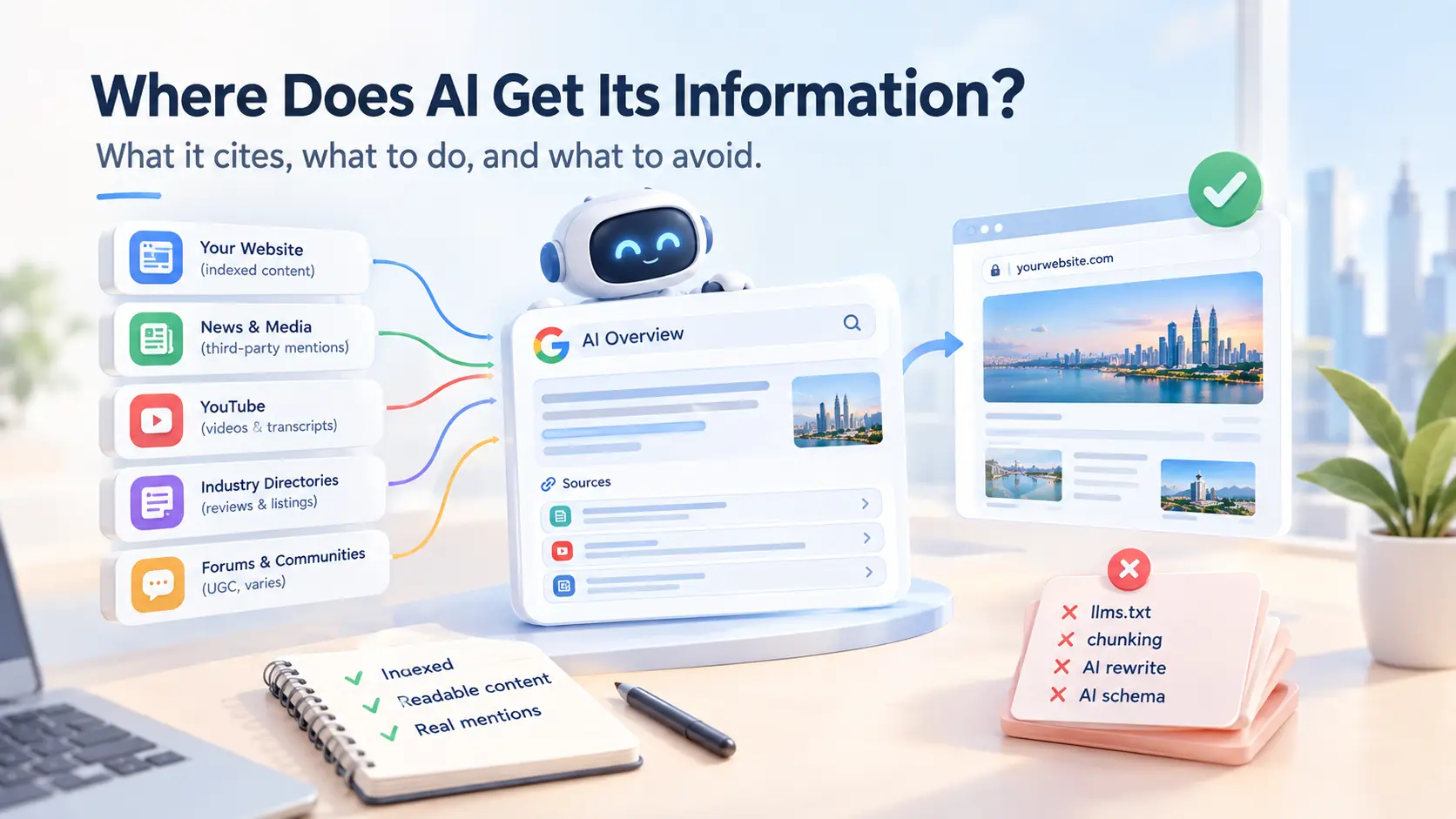
Getting cited by AI takes three things: a page crawlers can reach and index, content with a fact worth quoting, and mentions of your business elsewhere. Google’s own guide, updated in July 2026, is blunt about everything else: there are no extra technical requirements, no AI-specific files to publish, and no special markup to add.
How your customers look for you is changing. On 2 October 2026 I ran eight searches on google.com.my in English, Chinese and Malay, covering website and SEO topics. All eight triggered a Google AI Overview. By the time anyone opens a website, they have already read an AI summary of the answers.
I am Vern Chun from Milaos. I build websites and handle SEO for Malaysian businesses. This article is not a list of tricks. It covers the mechanics: where AI search gets its content, who it quotes, what you do not need to do, and how to check whether you are being cited at all.
What AI search actually reads
“AI search optimization” and the newer label GEO (generative engine optimization) describe the same work. It feels confusing because the platforms do not follow the same rules:
| Platform | Where content comes from (official docs) | What it means for you |
|---|---|---|
| Google AI Overviews / AI Mode | The same index and ranking systems as regular Search (Google’s guide) | If Google can index you normally, you are eligible to be cited |
| ChatGPT search | Content fetched by OAI-SearchBot | Block that bot in robots.txt and your pages cannot appear in its answers |
| Perplexity | PerplexityBot runs its own index, with Perplexity-User fetching pages live | Freshness matters a great deal; stale pages rarely get quoted |
Google’s explanation is refreshingly plain: AI features run on the same search systems, using retrieval-augmented generation to pull pages and query fan-out to split a complex question into several sub-queries. The work is still SEO. It is not a separate discipline.
One popular claim is worth correcting. Plenty of articles say ChatGPT runs on Bing’s index, so you must do “Bing SEO”. OpenAI’s documentation only says OAI-SearchBot is what surfaces sites in ChatGPT search. It never says that is the same as Bing. Make sure both Google and Bing can index you, and leave it at that.
Step one: can AI reach your site at all?
Before writing anything, rule out the three most common technical misses:
- Is the site indexed? Check Search Console or search
site:yourdomain.comfor Google; for ChatGPT and Perplexity, check that robots.txt and any CDN firewall rules are not blocking OAI-SearchBot or PerplexityBot. This one gets missed constantly, and plenty of sites lock themselves out with their own security settings. - Is the important content text? Many crawlers still do not run JavaScript. If your company profile, services and prices only exist inside images or client-rendered code, AI cannot read them, so it cannot cite them.
- Is Google’s generative AI feature switched on? Search Console has a “Search generative AI control” that launched alongside the AI reports on 3 June 2026. If someone turned it off, your content stays out of AI Overviews.
What to write so AI quotes you
The heaviest line in Google’s guide is that the biggest long-term factor is distinctive, non-commodity content: writing from genuine first-hand experience instead of summarising what everyone else already says. In practice, five habits carry most of the weight:
- Answer first. AI extracts a clear conclusion, not a warm-up. The opening paragraph of this article is deliberate.
- Turn questions into headings. Write the heading the way a customer would ask the question. When queries get split into sub-queries, question-shaped headings match more often.
- Give every number a source and a date. Numbers with provenance are safe to quote. AI behaves the same way.
- Keep pages current. Perplexity in particular is sensitive to freshness. Outdated content is not just inaccurate, it stops being quotable.
- Put a real name behind it. Bylines, credentials and case studies are how AI decides who is speaking.
One pattern from my 2 October test is worth noting: across the eight AI summaries, YouTube was cited 5 times, Zhihu 3 times, and Google’s own documentation 3 times. Video and official documentation punch far above their weight. The practical takeaway for a small business: a short video explaining your service gets quoted more often than most owners expect.
Why other people mentioning you beats self-promotion
AI does not weigh how you describe yourself. It weighs how others describe you: directories, business profiles, news coverage, review sites and forums. That is why Google’s guide pairs “distinctive content” with trust in the sources around it.
There is a trap here worth knowing: citation shares on UGC platforms swing wildly. In August 2026, after an unannounced change to ChatGPT search, Reddit’s share of ChatGPT citations fell 86.4 percent in four days. Over the same window YouTube dropped 88 percent and TikTok 72 percent (Search Engine Land, based on Promptwatch monitoring, which the analysts describe as provisional). Betting everything on one platform is risky. A spread of genuine third-party mentions is the real asset.
Four things you do not need to do
Most articles selling “AI search optimization” recommend the same four things. Google’s guide, updated 10 July 2026, rules out each one:
| The common advice | Google’s own words |
|---|---|
| Publish llms.txt for AI to read | “You don’t need to create new machine readable files… Google Search ignores them.” |
| Chop content into small chunks for AI | “There’s no requirement to break your content into tiny pieces for AI to better understand it.” |
| Rewrite your copy in AI-friendly phrasing | “You don’t need to write in a specific way just for generative AI search.” |
| Add AI-specific schema markup | “There’s no special schema.org markup you need to add.” |
llms.txt deserves a longer answer because it attracts the most noise. An Ahrefs study published in June 2026, covering 137,210 domains, found that 97 percent of llms.txt files were never fetched by any crawler in May 2026. Among the requests that did arrive, AI retrieval bots accounted for just 1.1 percent, while coding tools like Claude Code were the biggest readers (Ahrefs).
So I keep publishing mine. It costs almost nothing and it helps AI tools understand the site. But I never treat it as a visibility lever in search. Google’s guide also offers this line, which belongs taped to any AI SEO proposal you receive: be sceptical of third-party tools claiming inside access to Google’s systems.
How to check whether AI is citing you
Three official tools cover most of it:
| Tool | What it shows | Watch out for |
|---|---|---|
| Search Console generative AI report | Impressions from AI Overviews and AI Mode | Launched 3 June 2026 with impressions only, no clicks or queries; data starts 18 May 2026 |
| GA4 AI Assistant channel | Sessions arriving from ChatGPT, Gemini and similar | Launched 13 May 2026 (report); Perplexity is not included, and sessions without a referrer land in Direct, so the real number is usually higher |
| Ask the AI yourself | Whether ChatGPT, Perplexity and Google mention you for your target questions | Free, and a good baseline if you screenshot it and note the date |
Keep your expectations calibrated. A Pew Research Center study, published in July 2025 from 900 US adults and 68,879 searches, found that users clicked a traditional result in only 8 percent of visits when an AI summary appeared, against 15 percent without one. Just 1 percent clicked a link inside the summary. Google disputes how representative the study is, but the direction is not in doubt.
The point of this work is not immediate traffic. It is staying on the shortlist after your customer has already asked an AI about you.
What I found in Malaysia: three languages, three different games
On 2 October 2026 I ran eight searches on google.com.my. The pattern split three ways:
- English: crowded. For
ai search optimization malaysia, the AI Overview cited nine Malaysian companies, and the top nine organic results were all service pages. This space is already being fought over. - Chinese: open. For
ai 搜索 优化andgeo 优化, the AI cited Zhihu, Taiwanese and mainland Chinese sites. Not one Malaysian Chinese source appeared. - Malay: barely anyone. Malay queries were answered with Indonesian sites. Malaysian content was absent entirely.
The takeaway is not whether AI search matters. It is that if your customers search in Chinese or Malay, there is almost no local content for AI to cite right now, which makes it the cheapest position available. Once the gap fills, it will cost what English costs today.
A checklist you can run today
- Confirm in Search Console that your site is indexed and that the generative AI control is switched on
- Check robots.txt and your CDN firewall for accidental blocks on OAI-SearchBot, PerplexityBot and Googlebot
- Ask ChatGPT, Perplexity and Google your target questions, and screenshot whether you are mentioned
- Pick the question customers ask most and write one page that answers it in the first sentence, with question-style headings
- Add sources and dates to the numbers already on your site
- Align your Google Business Profile and directory listings with what your website says
Conclusion: treat AI search as a content quality review
AI did not change how search works. It moved the question of who is worth trusting to before the click. The official documentation, my own test and third-party research all point the same way: the sites that get quoted are the ones with clear structure, facts nobody else has, sources for their claims, and other people willing to mention them.
If you are still deciding whether you need a website at all, start with Do Small Businesses Still Need a Website in the AI Era?. If the site exists, this is the next step.
This is the work I do in web design and SEO. If you want to know whether AI can currently reach your site, and whether anything is citing it, request a free SEO and website health audit and I will send back a diagnosis you can verify line by line. If you are still weighing the budget, my SEO cost guide and website cost guide set the ranges first.
FAQ
Do I still need SEO now that AI answers so many searches?
Yes, and it is the same job it always was. Google's guide, updated in July 2026, states that AI Overviews and AI Mode run on the same index and ranking systems as regular Search, with no extra technical requirements. What changed is the goal: you are no longer only competing for a position on the results page, you are also competing to be the source an AI answer quotes.
How do I optimize for AI search?
Three conditions do most of the work: crawlers can reach and index your page, the page contains a fact or figure worth quoting, and other sites mention you. In practice that means allowing OAI-SearchBot and PerplexityBot in robots.txt, keeping your key content as text rather than images, opening with a direct answer, using question-style headings, and giving every number a source and a date.
How much does SEO cost in Malaysia?
Monthly SEO in Malaysia runs from about RM1,000 to RM15,000 depending on who does the work and what is in scope: freelancers charge roughly RM2,000 to RM4,000, boutique consultants RM4,000 to RM7,000, and agencies RM6,000 to RM15,000. A single-location business usually needs RM1,500 to RM3,000 a month. My SEO cost guide breaks down what each range includes.
How do I get ChatGPT to mention my company?
OpenAI's documentation is specific: allow OAI-SearchBot in robots.txt and permit its published IP ranges. Block that crawler and your pages cannot appear in ChatGPT's search answers. Beyond that, several third-party studies have found that ChatGPT's citations lean heavily on Wikipedia, news coverage and review directories, with brand websites making up a small share, so genuine mentions elsewhere matter more than self-promotion.
Can I trust what Google's AI Overview tells my customers?
Treat it as a starting point, not a final answer. Academic research has already found gaps and biases in AI Overview citations. The sensible habit is to follow AI summaries as leads and check original sources before acting on anything important, which is why every figure in this article carries a link and a date.
Should I publish an llms.txt file?
It will not help you in Google Search. Google's guide states plainly that Search ignores these files. An Ahrefs study of 137,210 domains, published in June 2026, found that 97 percent of llms.txt files were never fetched by any crawler at all. Its real audience is coding agents like Claude Code. The upkeep is trivial, so publishing one is harmless, but do not expect it to improve your AI search visibility.